

Step by step instructions

Hanging arrangement in orange

If you're a florist or designer looking for a creative idea to bring the magic of autumn into your designs, we've got just the thing for you. In this step-by-step guide, you will learn how to create autumnal hanging arrangements with warm textures in autumn colours.

Required utensils

Utensils Hanging fragment orange
  1. STYLIT sheep's wool felt "Toni" in the colour brick red
  2. STYLIT sheep's wool felt "Klausi" Felt in the colours ash grey, rust-orange and white-red
  3. STYLIT woollen cord "wicking thread" in the colours maroni brown, scarlet red, brick red and garnet red
  4. Orange-coloured decorative moss
  5. Gold leaf
  6. Two half polystyrene balls
  7. Rhipsalis cactus
  8. Aqua Colors Spray in black
  9. Double-sided adhesive tape
  10. Large plug-in clip

Tools: hot glue gun, scissors, pliers and bristle brushes

Materials and colours

Brick red OR04

RostoraNge BR24CO05

Garnet red VI09

Maroni brown BR49

The autumnal hanging arrangement is created with carefully selected materials from STYLIT. Use the STYLIT sheep's wool felt "Toni" in the unique colour brick red to give the arrangement a warm and earthy note to lend. en STYLIT sheep's wool felt "Klausi" offers further colour options such as ash grey, rust-orange and white-red, which are perfectly coordinated and High-contrast accents set.

For the perfect connection and suspension of the arrangement, use the high-quality STYLIT woollen cords "wicking thread" in the colours maroni brown, scarlet red, brick red and garnet red. This colour combination has a lively and uplifting effect thanks to the bright red tones. The addition of brown adds a touch of earthiness and creates a warm, autumnal mood.

The rich, earthy tones of the design are reminiscent of autumn and are perfectly complemented by the Rhipsalis cactus, which adds a refreshing touch of green. Together they create a stunning and harmonious aesthetic.

Step by step

Step 1:
Prepare the polystyrene ball
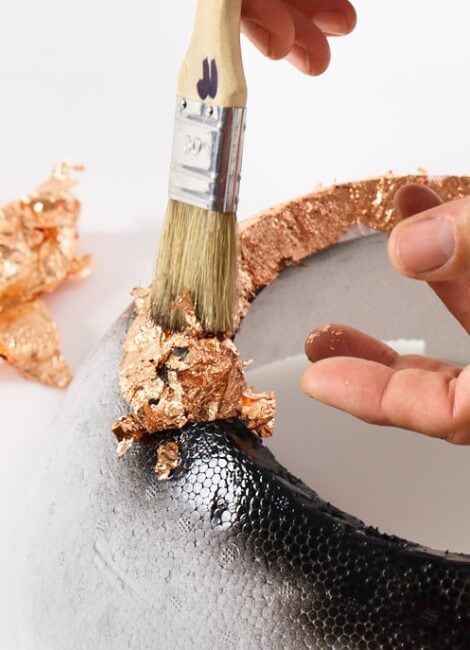
Take one of the two half polystyrene balls and cut off the top part. It is not necessary to make a perfect cut. Then spray the edge of the polystyrene ball with black spray paint. Repeat this step with the inside of the second half. Now take the half sphere that you cut out earlier and carefully dab the gold leaf onto the edge with a brush. This is best done before the acrylic paint has dried.
Autumn Arrangement Step 1
Autumn Arrangement Step 2
Step 2:
Connect balls

Connect the two halves of the ball by fixing them together with double-sided adhesive tape. Then connect the two polystyrene ball halves together using the large clip or a wire. Make sure that the wire sticks out a little.

Step 3:
Attach hanging cord

Attach a piece of felt underneath the wire and attach a piece of woollen cord "wick thread" about 40 cm long to it by knotting it around the wire.

autumn Arrangement Step 3
Autumn Arrangement Step 4
Step 4:
Wrap felt strip around ball

Cut strips about 3 cm wide and 30 cm long from the "Klausi" sheep's wool felt. Then wrap these strips around the polystyrene ball. Thanks to the double-sided adhesive tape, the felt will adhere well to the ball. Wrap the felt around the ball so that the white polystyrene is no longer visible, but the golden edge is still recognisable. Then take a strip of the single-coloured felt and wrap it exactly in the middle of the ball.

Step 5:
Set accents with woollen cord
Cut a piece of approx. 60 cm from each woollen cord and prepare it. Then wrap the cords around the felt-wrapped ball. Let your creativity run wild and criss-cross the cords as you wish. Either fasten the strings with a knot or hide the start and end points of the string under the felt.
Autumn Arrangement Step 5
Autumn Arrangement Step 6
Step 6:
Done!

Now place the Rhipsalis cactus in the hemisphere and add the final autumnal accents with the coloured dried moss in orange. To ensure that your cactus thrives, it is important to provide it with the right care and environment. Although it can tolerate minimum temperatures of 12 to 15 degrees Celsius, it thrives best at temperatures between 20 and 24 degrees Celsius. So make sure that you don't place it in areas with extreme temperature fluctuations or draughts.

Designer

Pascal Phaner
Pascal Phaner

Pascal Phaner is a talented floral artist with French roots and over 35 years of experience as a teacher of floral art. His international training in Taiwan, China and Tahiti has further deepened his expertise.

With his passion for orchids and tropical plants, he creates fascinating floral arrangements inspired by trends and unique combinations. Pascal enjoys sharing his knowledge and enthusiasm with others and delights customers worldwide with his unique creations.